


Stan's World - Patience Pays
Few phone calls are more disruptive to a financial planner’s day than those that start with: “My brother-in-law made a fortune on…”, or “My neighbor works for XYZ, and he said I should buy…” As the economist Charles Kindleberger said: “There is nothing so disturbing to one’s well-being and judgment as to see a friend get rich. Unless it is to see a non-friend get rich.”
Knowing that idle conversation, such as someone bragging about recent wealth accumulation, can alter the perspective of a formerly rational person, you can imagine how I felt when I read the title of a recent article in the Wall Street Journal: “Robinhood Traders Share Tales of Wealth.”1 The article talked about 1,500 attendees at a Robinhood conference, “…plumbers and small-business owners, mingling with corporate middle managers and stay-at-home parents. But many had something in common: investment portfolios that had grown so large in recent years they had quit their jobs to play the market full time.” Oh no!
Not only are there now a myriad of ways traders can play the markets, but there are also betting platforms that let you wager on markets, current events, and almost anything else you can imagine. Should you ever hear a wealth-creation tale that makes you consider a significant investment in a non-traditional asset (e.g., cryptocurrency, AI funds, vintage cars, data centers, etc.), let me say one word: STOP!
One can argue that it’s self-serving to hear a financial advisor - or even a mostly retired one - state that what he does for a living really works, but that’s not going to stop me from stating it anyway: in my experience, the tried and true, well-known, and well-proven methods to acquire sufficient assets to live a comfortable life both before and during retirement work. And I’m here to shout from the rooftop (well, my desktop) that instead of betting on their financial future, investors should practice a discipline called patience.
Investing for the long-term works! There will be bumps along the way, but patience and discipline have historically served investors well. To quote the economist, Paul Samuelson: “Investing should be more like watching paint dry or watching grass grow. If you want excitement, take $800 and go to Las Vegas.” (Samuelson was a Nobel prize winner in 1970 when $800 was a more significant bet than it is today.)
Were I to give my ‘have patience’ talk at a Robinhood conference, I suspect I would be booed off the stage. I would be met by people screaming: “I made my fortune in a week/month/year! Patience is for losers!” Of course, even I will concede it’s not patience alone that increases the odds of a successful retirement; other elements go along with it.
Long-time clients know what’s going to come next, but I’m going to say it anyway because we all need occasional reminders in a world where gratification is instantaneous, if not sooner. Let’s start with the fact that an investor must practice a disciplined approach to saving. Whether through a company 401(k) plan, a self-funded IRA, or after-tax savings in a brokerage account, funds must be set aside routinely for long-term investment.
In addition, investors must practice a disciplined approach to spending. Put simply, there are no savings if spending isn’t managed. The phrase ‘living within your means’ is not an idle expression; investors who fail to heed that advice may doom themselves to either a very long working career or a retirement lifestyle below their pre-retirement standard.
I trust you can all recite other noteworthy elements that put investors on a path to a successful retirement: periodic, appropriate rebalancing; asset placement for tax management; and strategic asset withdrawals for tax purposes2. (See the chart below, “The Power of Compounded Returns3,” as a visual reminder that patience pays off.)
Reciting and knowing are not the same as practicing and doing, and that’s where I fear many younger Americans will fall short. In a world where one can Google the question: “How can I get rich in a year?” and get answers, one must worry about how to maintain good financial habits. In other words, if you’re already a believer, think about giving this talk to your adult children or college-age grandchildren.
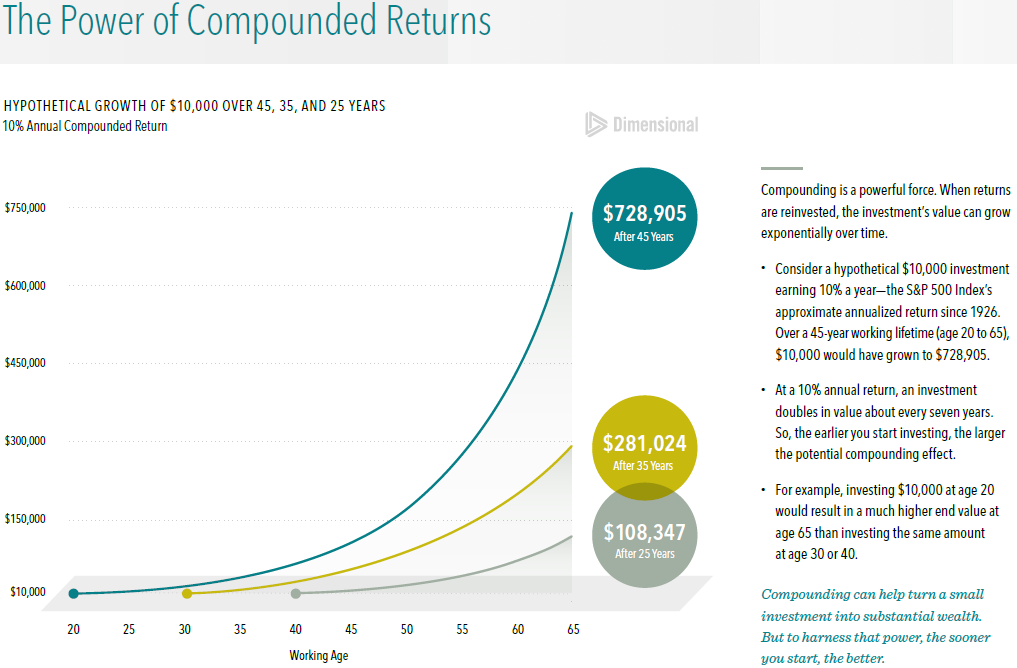
Whether you’re an investor who practices patience or someone who wonders if quick and easy might be for you, here’s an idea for those who aren’t already practicing it. Effective at year-end this year, start preparing a personal quarterly balance sheet. I’ve been doing one for more than 30 years, and it’s a terrific way to reinforce that all you’re doing really works.
Sure, there are quarters when your investments lose value, but those are the quarters where you can see your debt balances are still falling. Three more months of paying down the mortgage; the car loan; the education loan. A personal balance sheet can be a useful way to measure your financial progress over time, even during periods when investment values decline. Try it; if nothing else, it will help you to organize all your assets and liabilities on one sheet of paper. And that alone is an impressive accomplishment.
On the other hand, should you ever get an invitation to a Robinhood conference to share your get-rich-quick story, I’ll tip my cap to you. As for the rest of us, who are all trying to live our best life, know that the hard work is worth it.
1 Lang, Hannah Erin, and Rachel Mendelson. “Robinhood Traders Share Tales of Wealth.” The Wall Street Journal, 12 Oct. 2026.
2 Vanguard. Celebrating Vanguard Advisor’s Alpha: Clients and Their Advisors Thriving Together for 25 Years. 2025, https://unifyfa.com/wp-content/uploads/2025/10/Vanguard-Advisor-Alpha-2-2025.pdf
3 Dimensional Quick Takes, “The Power of Compounded Returns”, 2026.
S.F. Ehrlich Associates, Inc. (“SFE”) is a registered investment advisory firm in New Jersey that offers investment advisory, financial planning, and consulting services to its clients, who generally include individuals, high net worth individuals, and their affiliated trusts and estates. Additional disclosures, including a description of our services, fees, and other helpful information, can be found in our Form ADV Part 2, which is available upon request or on the SEC's website at www.adviserinfo.sec.gov/firm/summary/121356.
If you are an existing client of SFE, it is your responsibility to immediately notify us if there is a change in your financial situation or investment objectives for the purpose of reviewing, evaluating or revising any of our previous recommendations and/or services.
This newsletter is for informational purposes only and is not intended to be and does not constitute specific financial, investment, tax, or legal advice. It does not consider the particular financial circumstances of any specific investor and should not be construed as a solicitation or offer to buy or sell any investment or related financial products. We urge you to consult with a qualified advisor before making financial, investment, tax, or legal decisions.
Information contained herein has been obtained from sources believed to be reliable. While we have no reason to doubt its accuracy, we make no representations or guarantees as to its accuracy. The opinions and analyses expressed herein constitute judgments as of the date of this newsletter and are subject to change at any time without notice. Any decisions you make based upon any information contained in this newsletter or otherwise are your sole responsibility.
No graph, chart, formula, or other device can, in and of itself, be used to determine which securities to buy or sell, or when to buy or sell such securities, or can assist persons in making those decisions.
Any securities mentioned in this newsletter are for illustrative purposes only and should not be construed as investment advice or a recommendation to buy or sell. There is no guarantee that a particular client's account will hold any or all of the securities mentioned in this newsletter. Additionally, from time to time, SFE’s officers, directors, employees, agents, affiliates, or client accounts may hold positions or other interests in the securities mentioned in this newsletter.
Any historical index performance provided herein is for illustrative purposes and includes the reinvestment of dividends and income, but does not reflect advisory fees, brokerage commissions, and other expenses associated with managing an actual client account. An index is an unmanaged group of stocks considered to be representative of different segments of the stock market in general. Index performance does not represent actual account performance. One cannot invest directly in an index. A description of each index mentioned in this newsletter is available upon request.
Any hypothetical performance shown or discussed herein is for illustrative purposes only. Hypothetical performance results have inherent limitations, including: they are generally prepared with the benefit of hindsight; do not involve financial risk or reflect actual trading; and do not reflect the economic and market factors, such as concentration, lack of liquidity or market disruptions, trading costs, and other conditions, that might have impacted our decision-making when managing actual client accounts. Since trades have not actually been executed, hypothetical performance results may have under- or overcompensated for the impact, if any, of certain market factors.
It should not be assumed that future performance of any specific investment, investment strategy, or index (including any discussed in this presentation) will be successful or profitable or protect against loss.
Any forward-looking statements or projections herein are based on assumptions. By their nature, forward-looking statements involve a number of risks, uncertainties, and assumptions that could cause actual results or events to differ materially from those expressed or implied by the forward-looking statements. You should not place undue reliance on forward-looking statements, which reflect our judgment only as of the date this newsletter was published.